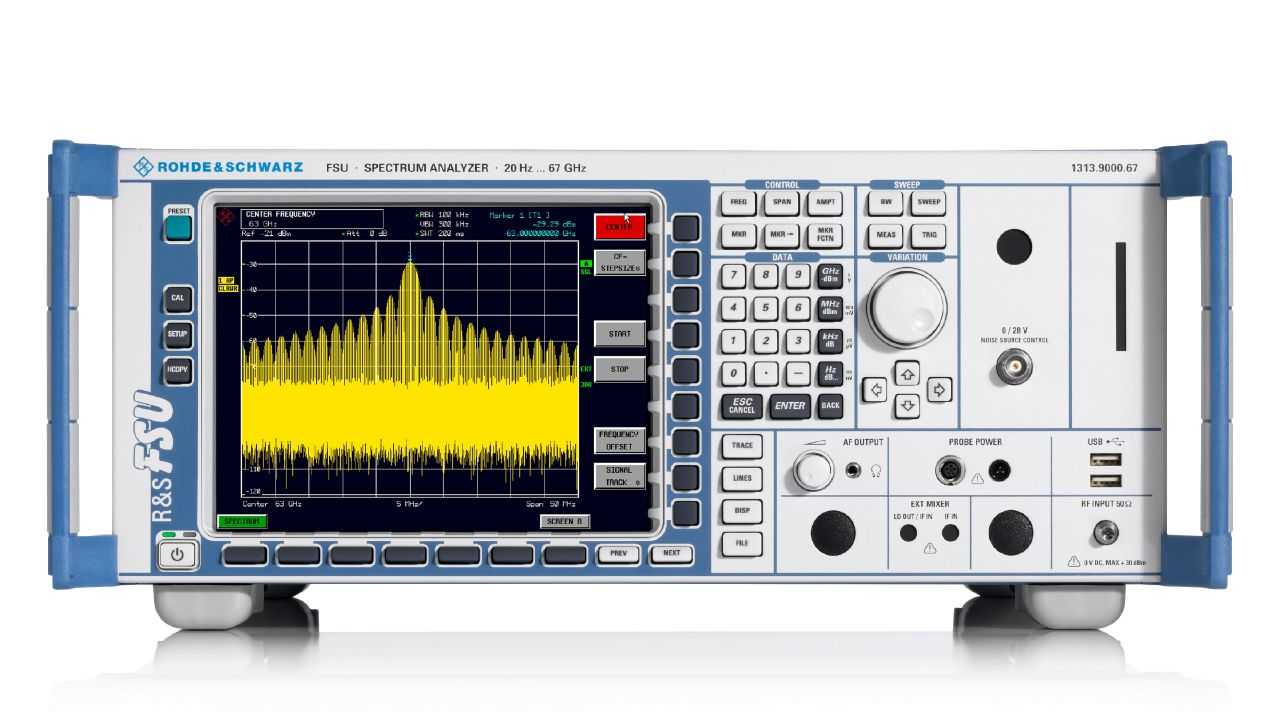
DUPRohde Schwarz FSU26 High Performance Spectrum Analyser, 20 Hz to 26.5 GHz
Size: 120 pcs
$ 91.11
0 out of 5
Rohde Schwarz FSU26 spectrum analyzers lead the way in dynamic range, phase noise, level accuracy, and resolution – all parameters required for developing, producing, and testing next-generation wireless devices. The Rohde & Schwarz FSU26 spectrum analyzer is a wide band, very sensitive receiver.It works on a “super-heterodyne receiver” principle to convert higher frequencies (normally ranging up to several 10s of GHz) to measurable quantities. The received frequency spectrum is slowly swept through a range of pre-selected frequencies, converting the selected frequency to a measurable DC level (usually logarithmic scale), and displaying the same on the CRT of the Rohde Schwarz FSU26. The CRT displays received signal strength (y-axis) against frequency ( x-axis).The Rohde Schwarz FSU26 is a high-performance spectrum analyzer with outstanding performance in phase noise, dynamic range and measurement accuracy that meets any challenge in RF analysis – in aerospace and defense or for general microwave applications up to 26.5 GHz.To handle the wide variety of measurement tasks in product development, an instrument must offer ample functionality and excellent performance in all areas of interest. Its wide dynamic range makes the R&S FSU26 an ideal tool for base station development and testing. That plus the excellent characteristics already incorporated in the standard model, e.g. < 0.3 dB total measurement uncertainty, gated sweep and IF power trigger.Some applications for Rohde Schwarz FSU26 Spectrum Analyzers include Site Monitoring: Verify that your transmitter’s frequency and signal strength is accurate. Interference: Before a system is installed, you use a Rohde & Schwarz FSU26 spectrum analyzer to verify that the frequencies (you plan to use) are not occupied or if the presence of a very strong signal will interfere with your new setup. Interference can be created by a number of different situations.Other tests that utilize the Rohde & Schwarz FSU26 spectrum analyzer features include antenna isolation, co-channel interference, adjacent channel power, occupied bandwidth, intermodulation, microwave or satellite antenna alignment, and characterization of components.Rohde Schwarz FSU26 Features:Frequency Range: 20 Hz to 26.5 GHzTOI > 20 dBm, typ.: 25 dBm1 dB compression: 13 dBm (0 dB RF attenuation)Displayed average noise level: –152 dBm at 2 GHz; –148 dBm at 26 GHz (1 Hz bandwidth)Typ. 77 dB ACLR for 3GPP, typ. 84 dB with noise correctionPhase noise typ.: –160 dBc (1 Hz) at 10 MHz carrier offsetNoise correctionFull choice of detectorsVersatile resolution filtersFull range of analysis functionsHigh dynamic rangeMeasuring frequency deviation after settlingPower measurementScalar network analysis with wide dynamic rangeDirect frequency range up to 67 GHzEasy expansion of the frequency range to 110 GHz with external mixers from Rohde & SchwarzSupport of external mixers up to 1 THzShort test cycles, high throughputFast time domain power measurementList mode: combined measurement of various parameters with a single commandUp to 70 measurements/s in zero span via IEC/IEEE bus, including trace data transfer859x/8566-compatible IEC/IEEE bus command setHigh measurement speedThe Rohde & Schwarz R&S FSU26 Spectrum Analyzer surpasses the proven excellent RF data of the R&S FSE and R&S FSIQ series of Spectrum Analyzers. Measurements calling for an extremely wide dynamic range are simpler, faster, and more reliable – in development, quality management, and production environments. The R&S FSU26 can rightly be called the new reference in spectrum analysis, with an unprecedented dynamic range.These characteristics make it easy to find small spurious signals even in the presence of strong carriers (e.g., at a base station). For 3GPP adjacent-channel power measurements, a figure of 84 dB ACLR allows good adjacent-channel power (ACP) ratios to be verified and demonstrated very simply and with high accuracy. Build your node B better than others, and prove it. The high harmonic second-order intercept point means the optimum dynamic range for multichannel cable TV measurements.OptionsB10 = External Generator ControlB16 = 100Base-T InterfaceB23 = RF Preamplifier, 3.6 GHz to 26 GHzB25 = Electronic Attenuator, 0 dB to 30 dB, and 20 dB preamplifierFirmware OptionsK9 – Power MeterK30 – Noise FigureK40 – Phase NoiseInclude:FSU analyzer;Manual.1 Year Warranty with Calibration Certificateopt K5(Modulation and Spectrum measurement on GSM/EDGE)/Fresh NIST traceable cal includedAligned 2022 with R&S softwareFully Tested, guaranteedReference LibraryManufacturer InformationBrochure

 Rohde Schwarz FSV30 Signal and Spectrum Analyzer
 Thermo Scientific TruScan RM Handheld Spectrometer